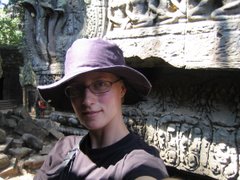
There has been a lot of changes in the past few months -- getting engaged in April and at the end of this month, I'll be moving from Malaysia to Singapore to take a new job. I'll be working at Singapore's National University(NUS). It's been ranked among the top 20 universities in the world by The Times of London and among the top 3 in Asia by Newsweek. I have always wanted to work in a university, but it is often very difficult to get the first job. Three years at NUS should open many doors for me.
I will be a lecturer there at the Centre for English Language Communication (CELC). Most of my students will be non-Singaporean undergrads and graduates who have enough English to pass NUS's initial exam but not enough to earn a degree in their disciplines. The Centre also hosts conferences and publishs a journal. So, there will an opportunity for me to continue to conduct research and perhaps get published again. I start at CELC on 2 July. If you would like to see more about where I will work, you can look at the NUS website at www.nus.edu.sg/celc.
Friday, June 22, 2007
Sunday, June 3, 2007
Being in Bali
I'm on a sort of working holiday during the school break in Malaysia. A friend of mine has done volunteer work here for the East Bali Poverty Project for the past 3 years. EBPP works with a group of very isolated hamlets on slopes of one of the biggest volcanoes on Bali. The Indonesian government didn't know of the hamlets' existence until the late 1990s. As a result, the people there had no schools, health care or access to the outside world. Some hamlets had an almost 50% infant mortality rate and a high rate of mental retardation. The mental retardation was mostly caused by iodine deficiency. The people grew only corn and cassava. Cassava hinders the body's ability to absorb iodine.
EBPP has been showing the villagers new farming techniques to prevent erosion, irrigate and fertilize organically. They have also introduced new crops such as tomatoes, spinach and potatoes. All of the children and women of child-bearing age receive iodine supplement tablets and they have been educating the villagers about bacteria, parasites and how to prevent them. The villagers also had trouble with water. In the rainy season there was too much and in dry season there was too little. They built a series of reservoirs to store and manage it. You can see more of their work and projects on their website at http://www.eastbalipovertyproject.org/.
Some of the villages requested EBPP to set up schools for the children since the nearest ones were a 3-4 hour walk. The children have 1 hour a week for English and this is where I am helping the foundation. The children have such little knowledge of the outside world that most of the English teaching resources available wouldn't be suitable for them. The children don't know about modern conveniences such as TV or telephones. They don't really understand concepts like hobbies or occupations. Nobody in their village has the time or resources to devote to hobbies and everyone they know is a farmer. The villages and the foundation wants them to have some knowledge of English so that the children can communicate with foreign donors, fill out forms and read simple things such as an instruction pamphlet or the directions on a bottle of medicine. My plan is to help the education team plan a syllabus to organize what the children should be learning over an extended period of time and to help them make their own textbooks and other classroom aids.
So far, it has been very interesting to think about ways the teachers can overcome the special problems they face in the villages. So interesting that I don't mind missing out on the typical tourist activities here on Bali.
Saturday, May 19, 2007
Holiday on Redang Island

At the end of April, Leo and I took a 4 day holiday to visit the east coast of West Malaysia, specifically we headed to Redang Island off the state of Terengganu. We left after lunch on a Sunday for the 4-5 hour drive. It actually took us much longer because of a heavy downpour that slowed traffic near Kuala Terengganu (KT). KT is the capitol of Terengganu, which is considered part of the Malay heartland and is one of the more conservative states in Malaysia. We checked into a budget hotel in the center of town and after we dried off we set out to sample the seafood and see what kind of nightlife KT offers. In an essentially dry state, the nightlife consists of sitting in cafes until late drinking coffee or tea and snacking. The rain and the fact that Sunday in Terengganu is the first working day of the week didn't keep people at home.
The next day we woke up early to catch the boat to Redang. The seas were choppy and the sky overcast. The weather would hold for our entire trip, making this the one snorkeling vacation that wouldn't send me home sunburned. Our resort was a budget one -- clean but without too many amenities. We spent most of our time snorkeling -- going out once on the first day and twice more on the second day. The seas there were full of fish. We rented an underwater camera the second day and you can see some of the photos if you click on photo albums under Links on the side bar. There was much more than you can see in the pictures. It was difficult to keep the camera steady in the waves so many of the pictures came out blurry. The third morning at Redang we caught the boat back to the mainland after breakfast.
We took the inland highway back which cut through small villages and oil palm plantations. Cows, chickens and monkeys wandered along the sides of the road. We stopped frequently to sample and buy some local delicacies, such as keropok (chips made from fish, prawns or squid) and dodol (a taffy-like sweet made from brown coconut syrup). We also stopped for lunch at a roadside stall. There were several fire department vehicles parked along the road there. We figured if the place was popular with the local fire department, it would do well for us. It served very traditional Malay food and proved to be one of the best meals of our entire trip. The girls running were unaccustomed to serving many white tourists. I think they were surprised that I could not only eat Malay food but that I cleaned my plate. We arrived back to Bentong in mid-afternoon. I had only two working days until the weekend. My relaxed post-beach holiday state made those two days seem like nothing.

Thursday, May 10, 2007
Santa Singh

One of my good friends here in Bentong died last month. He and his wife, Anthea, were some of the first friends I made. I met them almost accidentally in a coffee shop the first week I was in Bentong. They invited me along to their Sunday evening Scrabble game at Ted Miles' house, another friend. I have been playing Scrabble almost every Sunday ever since. Santa almost always got both v's and at some point in the game would have an excessive amount of vowels. Santa was a very kind man. He was a peacemaker who smoothed out other's rough edges or bridged gaps of misunderstanding. Ted, Anthea and I still play Scrabble every Sunday. I'll remember Santa whenever we sit down together, especially whenever I draw 2 v's or 3 i's.
Saturday, April 21, 2007
Save the Date!
Leo and I have set a date. We are going to get married on the 8th of December at St Joseph's Church in Kuching. For those of you outside Malaysia, that's in Sarawak, East Malaysia. You might know East Malaysia better as Borneo. Malaysia shares Borneo with Indonesia. It has the most interesting architecture of any church I've visited in Malaysia so far. It is also very big. Plenty of space for everyone, please come if it is possible.
Monday, April 16, 2007
Getting Married!

Early on the 1st April, Leo proposed to me. That evening we had gone out to dinner with a friend and then taken her to the airport. When we got back to Leo's apartment, it was very late. I was doing the usual things one does before going to bed, when I turned around and saw Leo kneeling on the floor and holding a ring. Although we had discussed getting married before, he took me by surprise. I, of course, said yes. We are planning to get married in December in Kuching. Kuching is Leo's hometown and the capitol of Sarawak, a state in East Malaysia. We do not have many details yet, but I will let my friends and family know the precise date as soon as possible. I hope that you will be able to come. Kuching is a very multicultural city -- Malays, Chinese and indigenous people all have very vibrant communities there. If it's possible, reserve a few days just to see the area. I know not all of you have met Leo so I'm attaching a picture of us.
Monday, March 12, 2007
Subscribe to:
Posts (Atom)